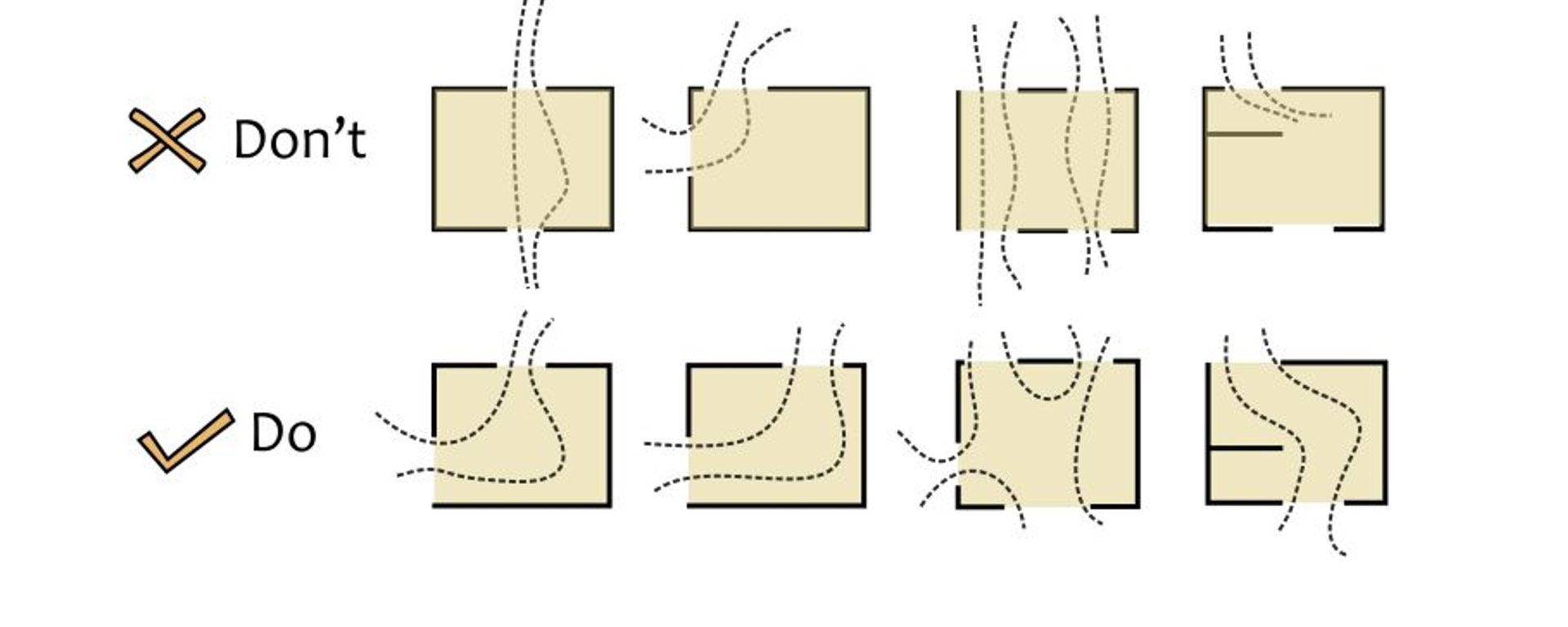
Fresh air and ventilation in teaching and learning spaces are important for enabling good quality education.
The US Environmental Protection Agency estimate that more than 10 million days of schooling are lost each year in the US because of asthma attacks among students (U.S. Environmental Protection Agency 2000). A study of 409 classrooms in Idaho and Washington in 2004 found that student absences jumped by 10–20 per cent in rooms with poor ventilation (Shendell et al. 2004).
In South Africa, classroom windows are often closed in winter because of the cold. This, combined with high student numbers, can lead to poor air quality in classrooms and drowsiness which affects learning.
Improving ventilation and quality in classrooms can be achieved through simple measures. Some of these are listed below.
- Open windows on both sides of rooms. This enables cross-ventilation which is much more effective than one-side ventilation (see diagrams above).
- Higher windows exhaust stale warmer air. These can be opened to improve ventilation in cold conditions.
- Leave windows open overnight. This ensures that stale air is flushed out and can ensure classrooms are cooler and more comfortable throughout the day.
- Open doors. This enables extra ventilation.
- Have regular breaks. Creating breaks supports the movement of air and helps reduce the accumulation of stale air in spaces.
- Restrict numbers. This reduces the potential for stale air to accumulate.
- Use fans. Where there are fans and electricity, these can promote ventilation by circulating air.
- Remove vegetation and obstructions around windows that may reduce ventilation. This enables easy movement and breezes through spaces.
Air quality and ventilation will be covered in the STE Teaching and Learning Environments Course.